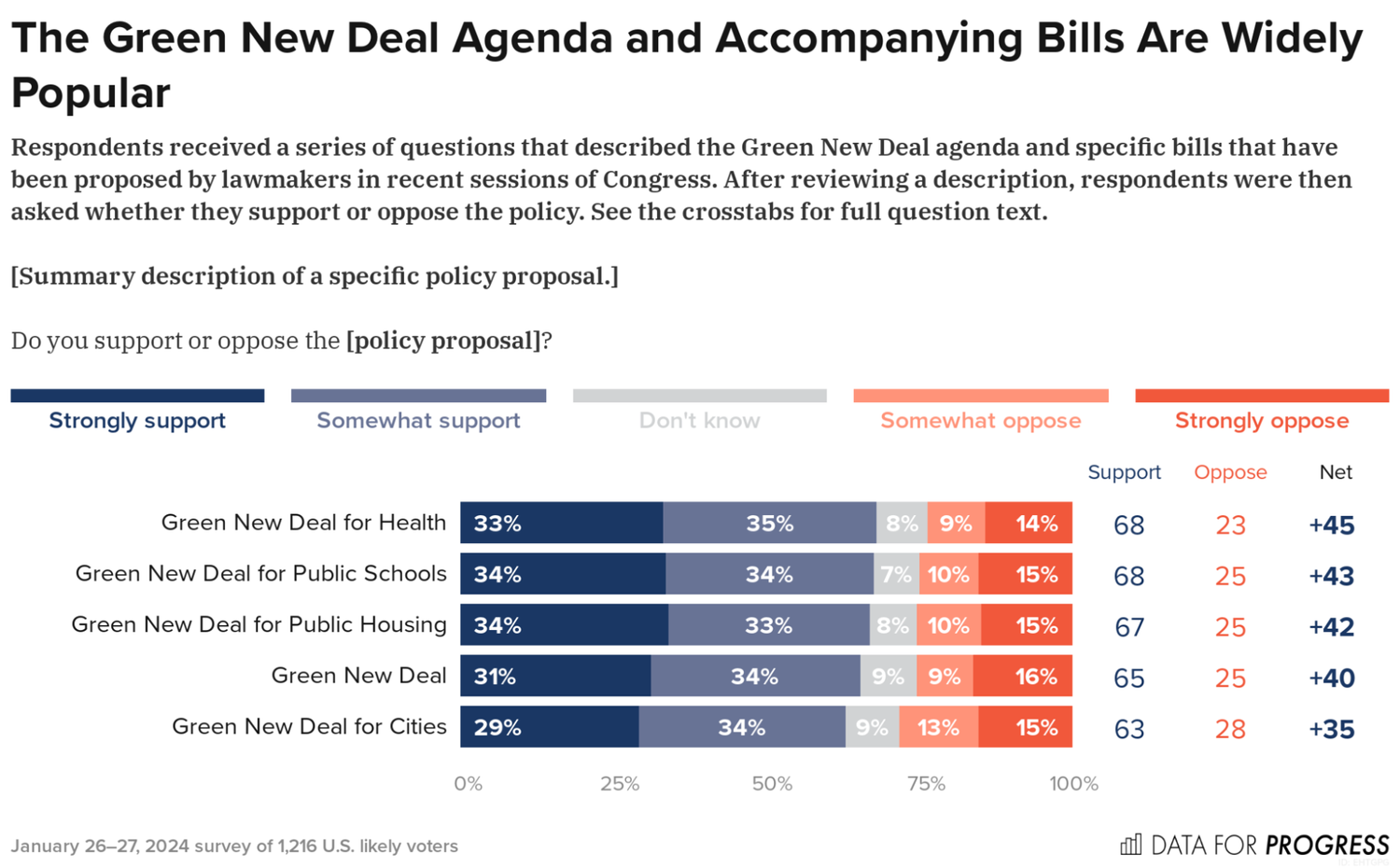
Green New Deal
The Green New Deal (GND) isn’t just one law. It's a 10-year vision, or governing agenda, involving many pieces of legislation aimed at combating the climate crisis, creating millions of good, union jobs, and ensuring a livable future for all people.
Goals of the Green New Deal:
achieve net-zero greenhouse gas emissions through a fair and just transition for all communities and workers;
create millions of high-quality, high-wage jobs; and ensure prosperity and economic security for all people of the United States;
invest in the infrastructure and industry of the United States to sustainably meet the challenges of the 21st century;
secure clean air and water, climate and community resilience, healthy food, access to nature, and a sustainable environment for all;
promote justice and equity by stopping current, preventing future, and repairing the historic oppressions of frontline and vulnerable communities.
-
We know that only the federal government has the power and resources to combat the climate crisis at the speed and scale that is necessary. But, even for the federal government, the project of decarbonizing our society is a massive project. This is why the Green New Deal is a framework for an “economic mobilization”
An economic mobilization “coordinates and deploys (“mobilizes”) a nation’s resources (its “economy”) in response to a national crisis.” (Rhiana Gunn-Wright)
During an economic mobilization a country’s entire economy and all of its resources are being directed at achieving a common priority. Many people say that the scale of the GND mobilization is impossible. But as a country, we’ve seen this before through the New Deal in the response to the Great Depression and in the industrial mobilization for World War II.
-
Factor 1: a triple focus on achieving decarbonization, reducing income inequality & addressing systemic oppression
Example: Senator Ed Markey & Rep. Alexandria Ocasio Cortez’s Civilian Civilian Climate Corps Act was designed to Create a Civillina Climate Corps that would employ 1.5 million Americans over 5 years to complete federally funded projects that help communities respond to climate change and transition to a clean economy. The CCC would complete projects that reduce carbon emissions, enable a transition to renewable energy, build healthier and more resilient communities, implement conservation projects with proven climate benefits, and help communities recover from climate disasters. At the same time, participants, or “corps members,” will receive education and training in coordination with local institutions, including labor unions, to usher them into good jobs, and especially good union jobs. Corps members would be paid $15 per hour, get full health care coverage, and critical support services such as transportation, housing, and childcare. Importantly, the program would ensure that environmental justice communities receive benefits of at least 50% of CCC and Partner Corps projects, and 50% of corps members would be recruited from these same communities. In 2023 Biden used executive action to create a scaled down version of the Civilian Climate Corps, called the American Climate Corps.
Factor 2: Shapes markets in order to create demand for low-carbon and non-carbon goods, making them the default and not the alternative to cartoon-intensive goods
Example: New York’s All Electric Buildings Act requires all new single-family and low-rise buildings be emissions-free by 2024 and all remaining new construction to comply by 2027, with limited exemptions when electrification is not technically feasible.
Factor 3: Mobilizes public investment for sector-wide decarbonization, while ensuring that the investment provides workers, marginalized populations, and vulnerable communities with both a path into the new economy and protection from disaster.
Example: The Green New Deal for Cities and Towns would “provide $1 trillion in federal funds to cities, towns, counties, states, Tribes, and U.S. territories to improve infrastructure and respond to the impacts of climate change. A key part of the legislation would be the requirements on how fund could be spend
At least half of the investments would go to communities that are most significantly impacted by climate change and pollution
Condition funding ensure that cities & towns work with tenant and community groups to prevent displacement
Legislation would include prevailing wage requirements, equitable and local hiring provisions, apprenticeship and workforce development requirements, project labor agreements and Buy America provisions
Factor 4: Builds power within and among those who are marginalized by prioritizing these communities in funding, policy design, and implementation, enabling local control whenever possible
Example: The Green New Deal for Public Housing would retrofit and upgrade 1.2 million federally managed homes, reducing their carbon emissions while creating hundreds of thousands of jobs. Grants for paid workforce development programs would train public housing residents and prepare them for the 250,000 jobs - all paid at prevailing wages. All grant applications would be approved by resident councils, giving communities control over how the money invested in their homes would be spent.